

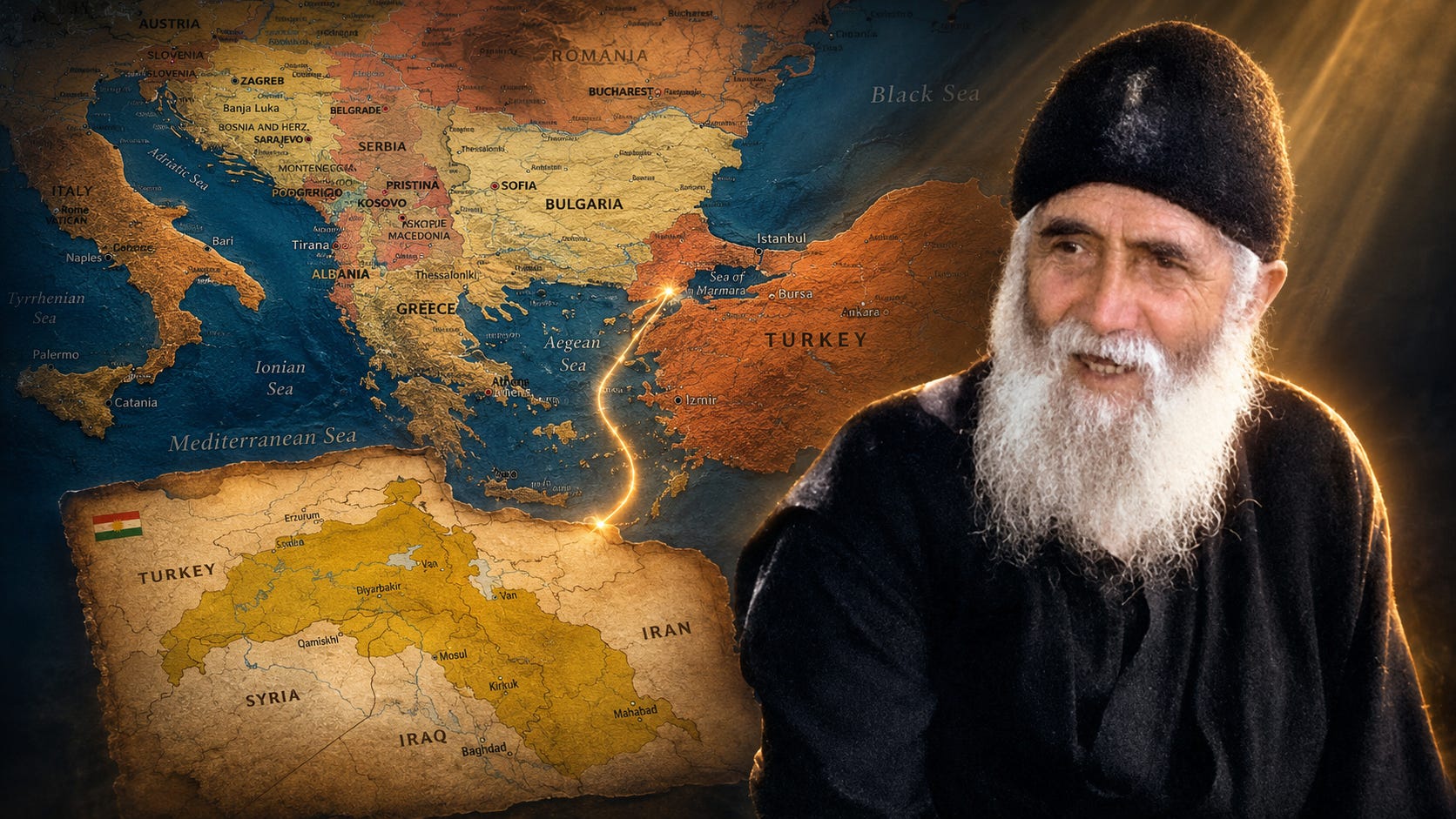
St. Paisios the Athonite
1We had the blessing of meeting a man who knew Elder Paisios for a full 15 years and had a special relationship with him. We travelled many kilometers to meet him in person, and the material he entrusted to us, I believe, is important, and we will try to present it gradually. We begin with a testimony, due to current events, related to Greek‑Turkish affairs…
Out of deep humility alone, this gentleman did not want us to publish either his name or the city where he lives: It was in 1990, when I saw the Elder. It was the last time, because shortly afterwards he fell ill. He brought me into his cell and sat on the bench. Every time I visited him, I would bring him a woolen undershirt for the cold. I also took the sack with me and placed it in a corner. He tells me, “Don’t touch the sack…” Inside the sack I had a small tape recorder that could record conversations from a distance, and my plan was that when I took out the undershirt, I would press it and it would start recording the Elder’s words. As soon as I stood up, he tells me, “K., don’t turn it on, it won’t work. Bring it here so I can see it too.” Since he understood, I took it and gave it to him. He asks me, “Whose is this?” I tell him, “It belongs to our friend V.”, who was known to the Elder. He began examining it and said, “It’s very nice, but know this: it would not have worked. Since you didn’t have a blessing, it would not have worked.”
At that moment someone called him from outside the cell, and that’s when I saw the Elder’s lunch: half a tomato, three olives, and half a slice of bread. When he came back inside, I told him, “Elder, I have a thought. What will happen to Greece? Tell me if it is blessed.”
The Elder tells me, “I will tell you… I,” he says, “will not see it. You will see it. It will happen in your days! You will live through this event… The problem will begin in Thrace. It will be a diplomatic incident that cannot be resolved. But then our so‑called “friends” will help our Greece, yet in reality their minds will be on the Dardanelles and European Turkey. From there it will begin, from Thrace!”
I ask him: will we take part in whatever happens?
“No!” he tells me:“We will reach the point of general mobilization. For the sake of the little children, the monks, and others who pray, God will have mercy on us and will not allow us to take part in the war that will occur. Those so‑called “friends” of ours and the others will fall into the trap…”
2Seeing the danger from the East for Thrace, he went to Komotini to support newly‑Christianized Muslims. He wanted to remain with them for a period to help.
3When asked in 1992 by a pilgrim: “When will these events take place?”
Elder Paisios replied: “When the United States declares the establishment of an independent Kurdish state.”
4In March 1994 I met Elder Paisios at the Monastery of Souroti. I was moved when he took my hand, and despite the critical state of his health, he told me the following: “You must not be distressed or afraid of Turkey. Turkey will be dissolved, and indeed, it will be dissolved by its own allies. In Bosnia a Muslim state will be formed (at that time such a state did not exist), but this event will turn against them, because in correspondence to that, later a Kurdish state will be created in the heart of Turkey.”
The Elder then, seeing that I was troubled by what I heard, told me again: “As you know, I do not read newspapers, but I learn these things from elsewhere…”
5A brother asked the Elder about the events in Serbia, and he said, among other things: “The Europeans are now doing the Turks a favor by granting independence to the small states where Muslims live (Bosnia, Herzegovina). But I see them dissolving Turkey in a polite way: the Kurds and the Armenians will rise up, and the Europeans will ask that these nations also become independent. Then they will say to Turkey: ‘We did you the favor over there; now, in the same manner, the Kurds and the Armenians must also become independent.’ Thus, ‘politely,’ they will cut Turkey into pieces.”
Saint Arsenios in Farasa used to tell the faithful that they would lose their homeland, but soon they would take it back.
6About Albania he told me: “When a goat wants to get beaten, it goes and scratches itself on the shepherd’s staff. That is what the Albanians are doing now. Leave them. Do not count them. Do not be afraid.”
7Many years before Kosovo was heard of, he told us: “Something is boiling over there, in Kosovo.”
8When I told him about Skopje, about Gligorov, the Elder said: “Let him shout. What can they do to us? They are a handful of people… Nothing is going to happen. They will find it all in front of them.” He never mentioned that they would take the name ‘Macedonia’ from us.
9I asked him what opinion he had about Skopje, and he told me: “Leave Skopje. Do not count them.”
10“I happened to be in a discussion with his fellow countrymen, who came from Farasa and lived in Konitsa, like the Elder. They were about forty people of the same age as the Elder. One of them asked him how he saw things with the Skopjans, whether Greece would have some involvement. The Elder said that there would be involvement, but Greece would be grazed lightly. He did not say with which countries the involvement would occur.”
- When did the Elder place this?
“He did not say exactly when. From a question one of his fellow countrymen asked, I understood that the time of involvement would not be far.”
11Defending the Greek identity of Macedonia, he posted in his guesthouse the text of the Prophet Daniel referring to the king of the Greeks, Alexander, and next to it a large paper icon of an Angel from a Serbian Monastery pointing to the text.
He compared the state of Skopje to a building constructed with bricks and with Farsala halva cut in the shape of bricks, destined one day to collapse.
The book of former Minister of Northern Greece, Mr. Nikolaos Martis, “The Falsification of Macedonia,” when he read it, delighted him. “Glory to God,” he said, “there are still patriots.” He took many copies and distributed them as a blessing. He even wrote a small praising poem, which Mr. Martis included in a new edition of his book.
12- “What will happen, Elder, with Macedonia?”
“The Saint Kosmas said it,” the Elder replied. “It is clear as daylight. They have neither strength nor right. Many villages will be destroyed, but of the three countries, one will remain.”
13“The Northern Epirotes should not be afraid, because one day they will be liberated by some brave young men. The liberators will not care about politics and will enter in order to help. The politicians, on the one hand, will rejoice, but on the other hand they are bound and cannot act. The other countries will accept it and will say that since it has happened, now it cannot be changed. Therefore, the Northern Epirotes should not be afraid, because the spiritual laws also operate. The pain for Northern Epirus is great, because we were one family and they separated us. It is like saying that some of your children must be separated from the others.”
14After offering a treat to the last visitors who arrived at that moment, the Elder again asked one of them:
Elder: “Will we take the City? What do you say?”
Christos: “I will go for Northern Epirus.”
Elder: “Let us take the City, Northern Epirus, seven people can take it!”
Christos: “Seven and me, eight!”
Elder: “Take it! And I will carry the relics of Saint Kosmas the Aitolian, which are heavy! What can we say, children, everything is said and written in our books (of the Church), but who reads them? The world understands nothing. They sleep with their tsarouchia on!”
All these excerpts were translated by The Holy Wisdom. Below you will find all the relevant sources of the words of St. Paisios the Athonite.
This testimony was published on the website National‑Pride on October 21, 2014. The website is no longer accessible: http://national-pride.org/2014/10/21/%CF%83%CE%BF%CE%B2%CE%B1%CF%81%CE%B7-%CE%BC%CE%B1%CF%81%CF%84%CF%85%CF%81%CE%B9%CE%B1-%CE%B3%CE%B5%CF%81%CE%BF%CE%BD%CF%84%CE%B1%CF%83-%CF%80%CE%B1%CE%B9%CF%83%CE%B9%CE%BF%CF%83-%CE%B1%CF%80%CE%BF/
Excerpt from Life of Elder Paisios the Athonite, page 699.
This testimony was published by AgiosPatrokosmas on January 10, 2018, on their website: https://agiospatrokosmas.gr/agioi/eisdhseis-apo-to-paron-kai-to-mellon
Alexandros Oikonomou, retired Air Marshal from Athens, as recorded in Testimonies of Pilgrims: Elder Paisios the Athonite 1924–1994 (2nd Edition), page 412.
Vessel of Election: “Thus, ‘Politely,’ They Will Cut Turkey Into Pieces,” page 143.
Testimonies of Pilgrims: Elder Paisios the Athonite 1924–1994, Vol. 1, page 259–260.
Testimonies of Pilgrims: Elder Paisios the Athonite 1924–1994, Volume 1, page 71.
Testimonies of Pilgrims: Elder Paisios the Athonite 1924–1994, Vol. 1, pages 87–88.
Testimonies of Pilgrims: Elder Paisios the Athonite 1924–1994, Vol. 1, pages 259–260.
Christos Tsetos, retired Air Force squadron leader, Thessaloniki. Testimonies of Pilgrims: Elder Paisios the Athonite 1924–1994, Vol. 1, page 263.
Life of Elder Paisios the Athonite, page 699.
Paisios the Monk: Prophecies & Teachings, page 438.
Paisios the Monk: Prophecies & Teachings, D.D. Liakopoulos, D. Messiniatis the monk, page 434.
A Chosen Vessel, page 219.